
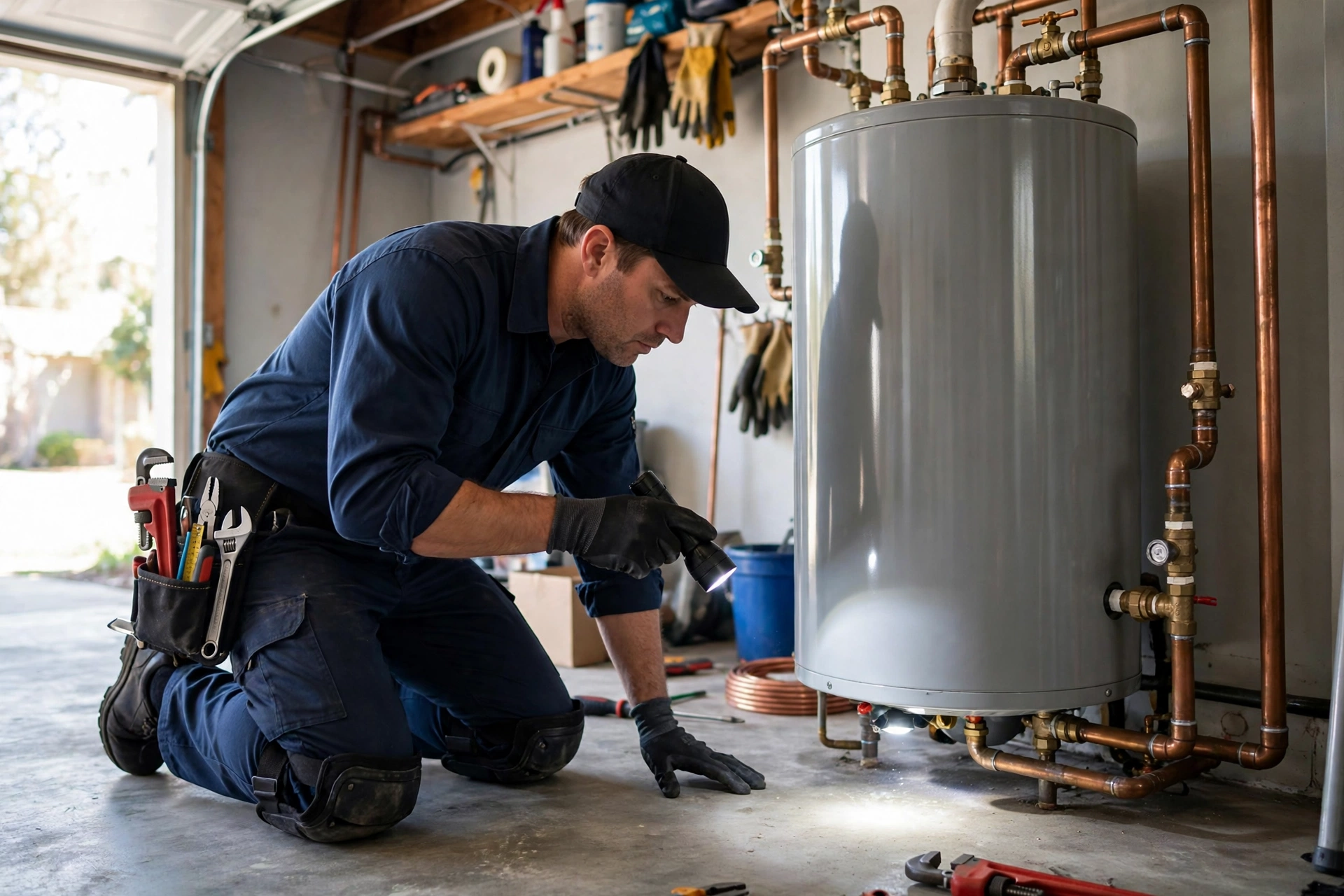
Electric water heaters have no flame — just two metal heating elements immersed in the tank, doing all the work. When one fails, the symptoms are distinctive: water that never quite gets hot, hot water that vanishes halfway through a shower, or a breaker that keeps tripping. Here is how to recognize element failure, why sediment is usually involved, and what repair looks like.

How heating elements work
Most residential electric water heaters have two elements: an upper and a lower, each controlled by its own thermostat. They do not run simultaneously — the upper element heats the top of the tank first, then hands off to the lower element to heat the rest. This sequencing matters for diagnosis, because each element's failure produces a different symptom. Elements are essentially high-powered immersion heaters, and like any electrical component sitting in hot water for years, they eventually burn out or short.
The classic failure symptoms
- No hot water at all. If the upper element fails, nothing heats — you get cold water from the hot tap from the start.
- Lukewarm water that never gets fully hot. A weak or partially failed element heats slowly and never reaches the thermostat setpoint.
- Hot water runs out fast. The signature of a dead lower element: the upper portion heats normally, so the first few minutes feel fine, then it turns cold because the bulk of the tank never heated.
- The breaker keeps tripping. An element that has shorted to ground draws excessive current. Reset the breaker once; if it trips again, the element (or its wiring) needs professional attention.
- Humming or buzzing from the tank. A failing element can vibrate or arc, producing sounds a healthy element never makes.
The sediment connection
In Apache Junction's hard water, sediment is the number-one element killer. Minerals settle to the tank bottom and bury the lower element, which then overheats trying to heat through the insulating scale layer. Overheated elements burn out years early. This is why a lower-element failure in a never-flushed tank is rarely just bad luck — it is the predictable result of sediment, and replacing the element without flushing the tank just starts the countdown again.
How professionals test elements
Testing an element requires a multimeter and strict safety procedure: power off at the breaker, verified dead with a non-contact tester, then resistance measured across the element terminals. A healthy element shows a specific resistance range; an open (infinite) reading means a burned-out element, and continuity to ground means a shorted one. Technicians also inspect for the telltale signs — a split sheath, heavy scale coating, or a burned terminal. This is a quick diagnostic when done by someone who does it daily, and it definitively separates element failure from thermostat failure, which can mimic it.
What replacement involves
Element replacement means draining the tank below the element port, unscrewing the old element, cleaning the port threads, and installing the new element with a fresh gasket — then refilling the tank completely before restoring power. That last step is critical: turning on power to a dry element destroys it in seconds (called "dry-firing"). Because the tank must be partially drained anyway, element replacement is the perfect time for a full flush and an anode rod check. Our heating element replacement service bundles all three, so the repair actually extends the tank's life instead of just patching the symptom.
When element failure means a bigger decision
One failed element in a mid-life tank is a straightforward repair. But repeated element failures, heavy rust in the drained water, or a tank pushing past its expected lifespan suggest the tank itself is deteriorating — and elements are not worth replacing on a tank that is about to leak. There is also the efficiency angle: an older electric tank with a fresh element still heats with yesterday's insulation and controls. When the repair estimate starts to look significant relative to replacement, or when the tank shows any sign of shell corrosion, put the money toward a new unit instead of nursing the old one along. A good technician will tell you which situation you are in before quoting the work.
Related Questions
How long do water heater elements normally last?
In soft water with regular flushing, many years. In hard-water areas like Apache Junction without flushing, the lower element often fails much earlier — sediment is the deciding factor, not the calendar.
Can I replace a heating element myself?
It is physically possible, but the 240-volt power, the risk of dry-firing a new element, and the seized-in-place fittings make it a job where professional service pays for itself in safety and correctness.
Why did my new element fail within months?
Almost always sediment: the tank was never flushed, so the new element overheated in the same scale bed that killed the old one. Or the tank was not fully refilled before power was restored.