
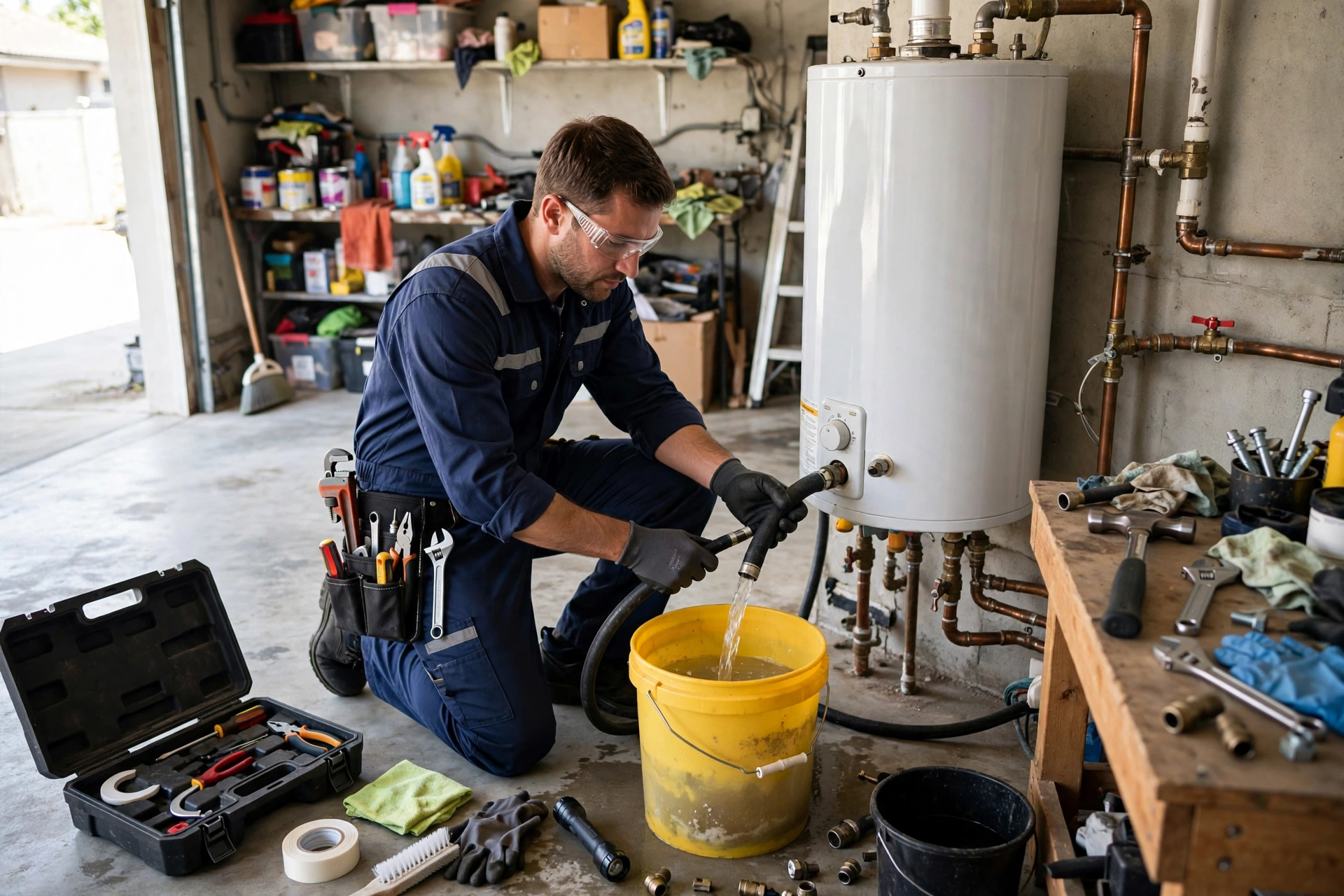
Draining your water heater — usually as part of a flush to remove sediment — is the single highest-value maintenance task a homeowner can perform. Done right, it is safe and straightforward. Done wrong, it can scald you, dry-fire an element, or crack a tank. This step-by-step guide covers the safe way for both gas and electric heaters, the way we do it on service calls across Apache Junction.

Why draining matters
Sediment — calcium and mineral scale from hard water — settles at the bottom of every tank heater. Over time it forms an insulating layer between the burner or element and the water, forcing the tank to overheat to do its job. That overheating wastes energy, bakes scale onto elements, and stresses the tank bottom until it cracks. A periodic drain-and-flush removes the loose sediment before it compacts into concrete-like scale. In hard-water areas, this is not optional maintenance; it is the difference between a heater that lasts and one that does not.
What you will need
- A standard garden hose long enough to reach a safe drainage point (floor drain, driveway, or landscaping — hot water kills plants, so aim carefully)
- An adjustable wrench or channel-lock pliers
- A bucket for the first test draw
- Work gloves — the drain valve and first water out will be hot
- For electric heaters: knowledge of which breaker controls the heater
Step-by-step: draining safely
Step 1 — Cut the heat source
Electric: switch the water heater breaker OFF at the panel. Gas: turn the gas control valve to "pilot" or "off." This is non-negotiable — heating an empty or partially empty tank damages it fast.
Step 2 — Shut off the cold water supply
Close the cold-water shutoff valve on the pipe entering the top of the heater. This stops new water from entering while you drain.
Step 3 — Let the water cool
Ideally, wait several hours after the last hot water use, or run the hot tap until the water is merely warm. Draining a full tank of scalding water through a garden hose is how burns happen.
Step 4 — Connect the hose
Thread the garden hose onto the drain valve at the tank's bottom. Run the other end to your drainage point, keeping the hose as straight and downhill as possible — kinks slow or stop the flow.
Step 5 — Open a hot water tap
Open a hot faucet somewhere in the house. This lets air into the system so water can actually flow out — without it, the tank holds vacuum and barely drains.
Step 6 — Open the drain valve
Open the drain valve slowly. The first water out is the hottest and dirtiest — that is normal. Let the tank drain, then briefly crack the cold-water supply open a few times to stir up remaining sediment ("power flushing") until the water runs clear.
Step 7 — Close up and refill
Close the drain valve, remove the hose, turn the cold water supply back on, and let the tank fill completely — wait until water flows steadily from the open hot tap with no sputtering. Only then restore power or turn the gas back to its normal setting. Restoring heat to a partially filled tank is the classic dry-fire mistake.
Gas vs. electric safety notes
Electric heaters demand extra respect for the breaker: verify power is truly off, and never restore it until the tank is completely full. Gas heaters demand respect for the pilot: if you turned the gas fully off, you will need to relight the pilot per the manufacturer's instructions, and if you smell gas at any point, stop and call the gas utility. Both types demand respect for the water temperature — assume everything is scalding until proven otherwise.
Mistakes that cause damage
- Draining without cutting heat first. The fastest way to kill an electric element or overheat a gas tank.
- Forcing a stuck plastic drain valve. Old plastic valves snap off. If the valve will not open gently, stop — a broken valve means an uncontrolled drain, and that is a plumber call.
- Skipping the open hot tap. The tank air-locks and you will think it is empty when it is not.
- Restoring power before the tank refills. Dry-fired elements die in seconds.
- Draining onto something that cannot take hot water. Route the hose thoughtfully.
If any step makes you uncomfortable — a seized valve, confusing wiring, or a heater you have never serviced — there is no shame in calling (833) 713-2101. A professional flush in Apache Junction includes the anode check and takes less than an hour.
Related Questions
How often should I drain my water heater?
In hard-water areas like Apache Junction, once a year is the standard recommendation. If you have never drained yours and it is several years old, go gently — disturbing decades of sediment can clog the drain valve.
Should I drain the entire tank or just flush a few gallons?
A full drain with a few cold-water churn cycles removes the most sediment. If the drain valve is old and fragile, some technicians prefer a partial flush to avoid stressing it — judgment call based on the valve's condition.
My drain valve is stuck — what now?
Do not force it, especially a plastic valve. Call a professional; we can often replace the valve or flush through alternate means without flooding your garage.