
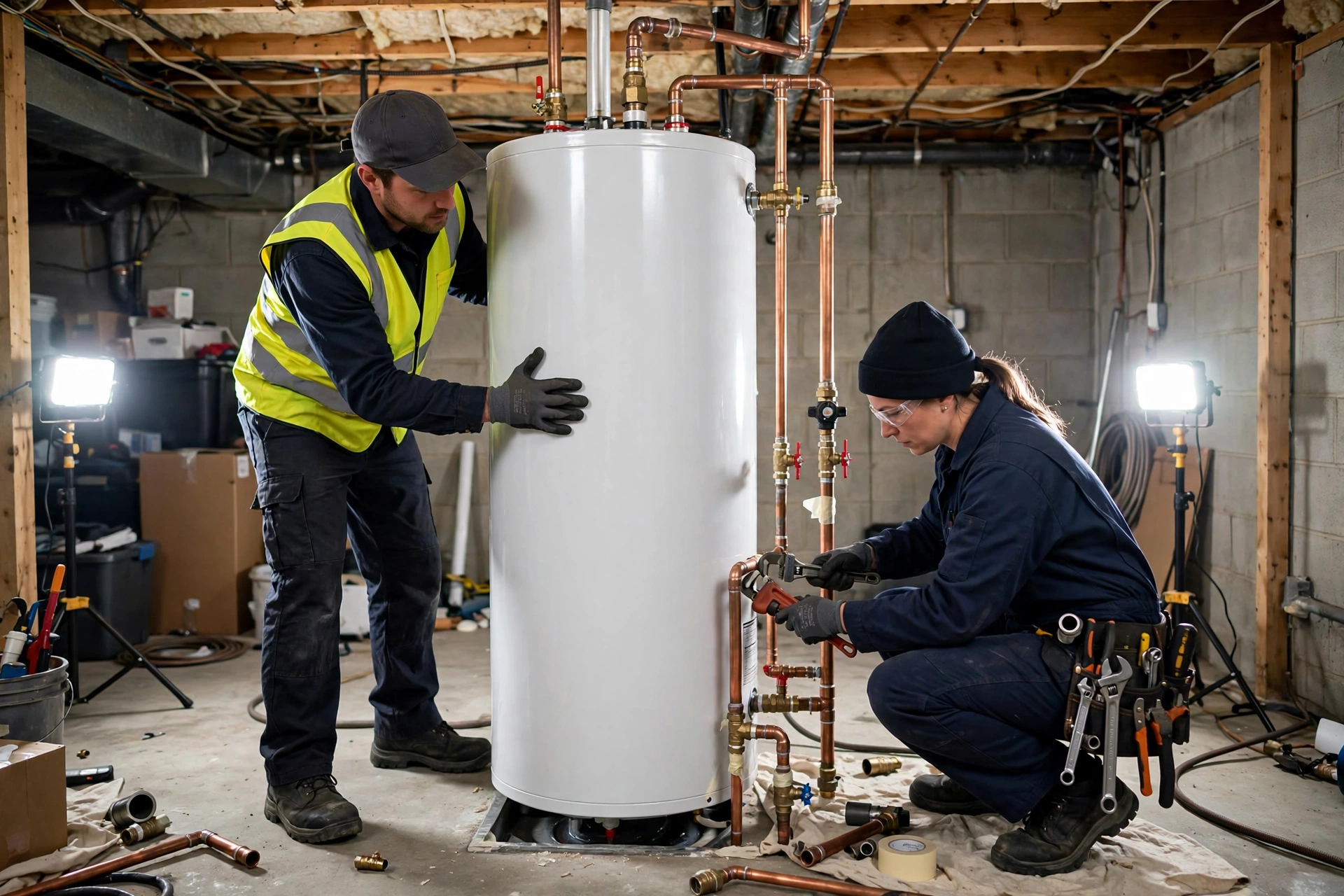
"Can this be fixed, or do I need a new one?" — it is the first question almost every Apache Junction homeowner asks us, and the honest answer is: it depends on three things. This guide gives you the same framework technicians use: the unit's age, the type of failure, and the efficiency picture. Work through it and you will know which side of the line you are on before anyone quotes you a number.

Start with age: the master variable
Age does not decide everything, but it frames everything. A tank in the first half of its expected life deserves the benefit of the doubt — most failures at that age are component failures (valves, thermostats, elements, anodes), and components are replaceable. A tank in the second half of its life changes the math: every repair dollar competes with replacement dollars, because the tank's remaining lifespan is short no matter what you fix. Find your manufacture date from the rating plate, be honest about where the unit sits in its life, and let that anchor the rest of the decision.
The cost-ratio rule of thumb
Technicians widely use a simple guideline: if a repair costs a large fraction of what a new unit costs — roughly half is the traditional threshold — replacement usually wins, especially on an older tank. The logic is straightforward: that repair buys you the remaining life of an old tank, while replacement buys you a full new lifespan plus a fresh warranty. On a young tank, even a significant repair makes sense because you are protecting many remaining years. No rule of thumb replaces a real quote, but this one keeps the decision honest.
Problems worth repairing
- Failed heating element or thermostat on an otherwise sound tank — routine, and the tank gets years more life.
- Dripping T&P or drain valve — valve replacements are straightforward and do not reflect on the tank.
- Spent anode rod — replacing it is literally buying the tank more years.
- Pilot or thermocouple issues on a mid-life gas unit — small parts, big restoration.
- Leaking fittings or connections at the top of the tank — plumbing repairs, not tank failures.
Signals that point to replacement
- The tank itself is leaking — a weeping seam or pinhole in the shell cannot be reliably repaired. This is the clearest replace signal there is.
- Age plus any major failure — a failed gas valve or multiple simultaneous issues on an old tank is the unit telling you it is done.
- Rusty hot water that persists after anode replacement — interior corrosion has won.
- Repeated repairs — the third service call in two years is money that should have gone toward a new unit.
- Capacity no longer fits the household — if you have been running out of hot water for years, a like-for-like repair preserves a problem; replacement is the moment to size correctly.
The efficiency question
Water heater efficiency has improved over the years — better insulation, smarter controls, and heat-pump options that did not exist a generation ago. If your unit is old enough, the operating savings of a modern replacement meaningfully offset its cost over its life. This rarely decides a repair-vs-replace call on its own, but on a borderline decision — an aging tank with a mid-size repair needed — efficiency tips the scales toward replacement. It is also the moment to reconsider fuel type and tank vs. tankless, since you are buying anyway.
Your decision checklist
- How old is the unit, honestly? (Check the rating plate date code.)
- Is the failure in a replaceable component or in the tank shell itself?
- Does the repair cost approach a large fraction of replacement?
- Has this unit needed frequent repairs lately?
- Does the current capacity and efficiency still suit the household?
If the answers cluster toward "old, tank-level failure, expensive repair, frequent issues" — replace. If they cluster toward "young, component failure, reasonable repair, first problem" — repair. Genuinely torn? That is exactly what a diagnostic visit is for. Call (833) 713-2101 — we will give you the honest read on your specific unit, including when the honest read is "just fix it." Our water heater replacement service covers full sizing and installation when replacement is the call.
Related Questions
My tank is leaking from the bottom — can it be repaired?
Almost certainly not. A leak from the tank shell itself means interior corrosion has breached the steel, and patch repairs on pressurized tanks don't hold. Plan for replacement.
Is it worth replacing an anode rod on an old heater?
If the tank is otherwise sound and not leaking, yes — it's the cheapest way to buy more years. If the tank is already rusting through, save the money toward replacement.
Should I switch to tankless when replacing?
It depends on your gas supply or electrical capacity, hot water usage patterns, and budget. Tankless excels for endless hot water and space savings; tanks win on simplicity and upfront cost. Worth discussing during the replacement quote.