
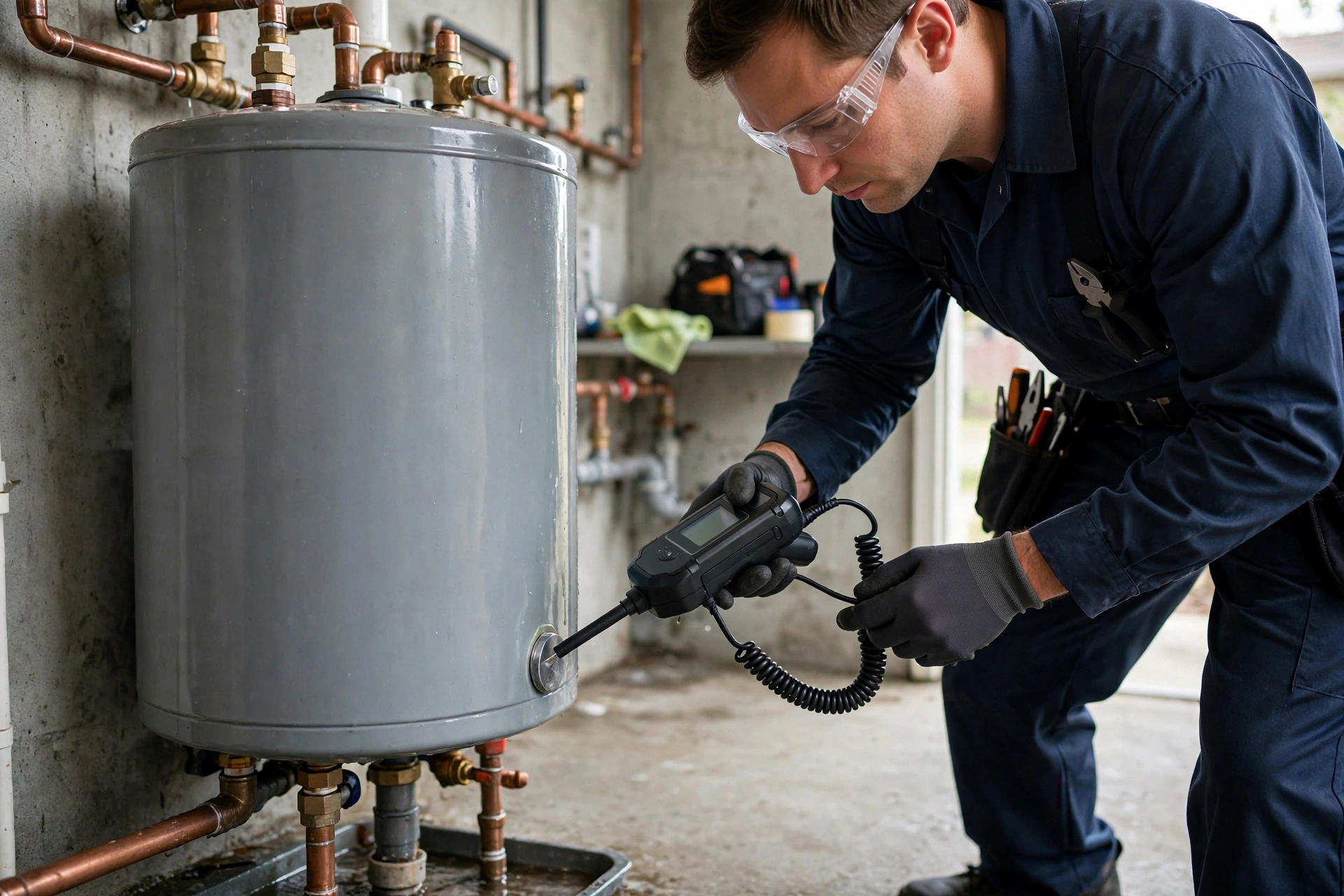
Not every water heater leak announces itself with a puddle. Some weep slowly from a fitting, wick into drywall, or evaporate off a hot tank before you ever see them — leaving only a musty smell, a damp patch that comes and goes, or a water bill that creeps upward. Professional leak detection is the systematic process of finding these hidden leaks. Here is how it works, and which methods you can try yourself.

Start with your eyes and hands
Every professional detection job begins the low-tech way: a slow, deliberate inspection. We look at every joint, valve, and seam with a flashlight — top fittings, the T&P valve and its discharge pipe, the drain valve, element and thermostat covers on electric units, the tank base, and the floor around it. Then the hand test: run a dry hand (or a dry paper towel) along pipes and under fittings. Skin detects moisture that eyes miss, especially slow seeps that have not yet formed drips. Half of all "hidden" leaks are found in this first pass — they were only hidden because nobody looked closely.
The dry test
The simplest definitive method: dry everything completely — tank base, fittings, floor, pan — with towels, then wait and re-check at intervals. Mark suspect spots with a pencil or tape. When moisture reappears, its location tells the story: water at the base points to the tank or drain valve; water at the top points to supply fittings; water only under the discharge pipe points to the T&P valve. The dry test separates active leaks from old stains and condensation, which is exactly why professionals insist on it before recommending repairs.
Tracing the source upward
Water runs downhill and wicks outward, so the visible damp spot is rarely the source — the source is above it. Professionals trace upward methodically: damp base, check the drain valve and tank seam just above; damp wall behind the heater, check the top fittings and supply lines; water in the pan, check everything above the pan line. This discipline prevents the classic mistake of replacing a drain valve when the actual leak is a supply fitting two feet above it, dripping down the tank's side.
Dye and paper tests
For intermittent or ambiguous seeps, food coloring or plumber's dye tablets in the tank water make the leak's path visible — colored water appearing at a fitting or seam is unambiguous. Paper towels wrapped around suspect joints and left for hours show exact drip points as expanding wet spots. These methods cost almost nothing and are well within a careful homeowner's reach; they are also what we use to confirm a diagnosis before quoting a repair.
Moisture meters and thermal imaging
When water has wicked into drywall, baseboards, or flooring, pin-type moisture meters quantify exactly how wet the material is and map how far the damage extends — critical for knowing whether you are dealing with a surface damp spot or soaked framing. Thermal imaging cameras detect the temperature difference of evaporative cooling, revealing wet areas inside walls without opening them. These tools answer the question "how bad is it really," which matters for both repair scope and insurance documentation.
Pressure and isolation tests
When the leak's origin is genuinely unclear — water appears but no fitting shows moisture — isolation testing narrows it down. The water heater can be valved off from the house plumbing and its pressure monitored: if the isolated tank holds pressure, the leak is in the house lines; if it drops, the tank or its immediate connections are the source. Similarly, shutting the tank's supply and watching whether dampness continues separates plumbing leaks from condensation and external water sources. This is the methodical end of detection, and it is definitive.
When to call a professional
Try the visual inspection, the hand test, and the dry test yourself — they are safe and genuinely useful. Call for professional detection when: the source stays ambiguous after drying and watching; moisture is inside walls or under flooring; the T&P discharge pipe is wet (pressure issues need proper diagnosis); or you find the leak but it involves gas connections, electrical components, or the tank shell itself. Hidden leaks reward patience and punish guessing — a correct diagnosis is always cheaper than the wrong repair. Our water heater leak detection service covers Apache Junction and the East Valley, and if you are seeing unexplained dampness around your heater, call (833) 713-2101 before a hidden seep becomes visible damage.
Related Questions
Can a water heater leak without any visible water?
Yes. Slow seeps can evaporate off a hot tank, wick into drywall, or drain into a pan's drain line invisibly. Musty smells, warm damp patches, and unexplained moisture are the usual clues.
How do I know if it's a leak or just condensation?
The dry test settles it: dry everything, then check back. Condensation forms evenly on cold surfaces during humid weather and doesn't return from a specific point; a leak reappears at its source.
Will my insurance cover hidden leak damage?
Often the resulting water damage is covered while the plumbing repair itself isn't — but gradual, long-term leaks may be excluded. Document everything with dated photos and address leaks promptly.