
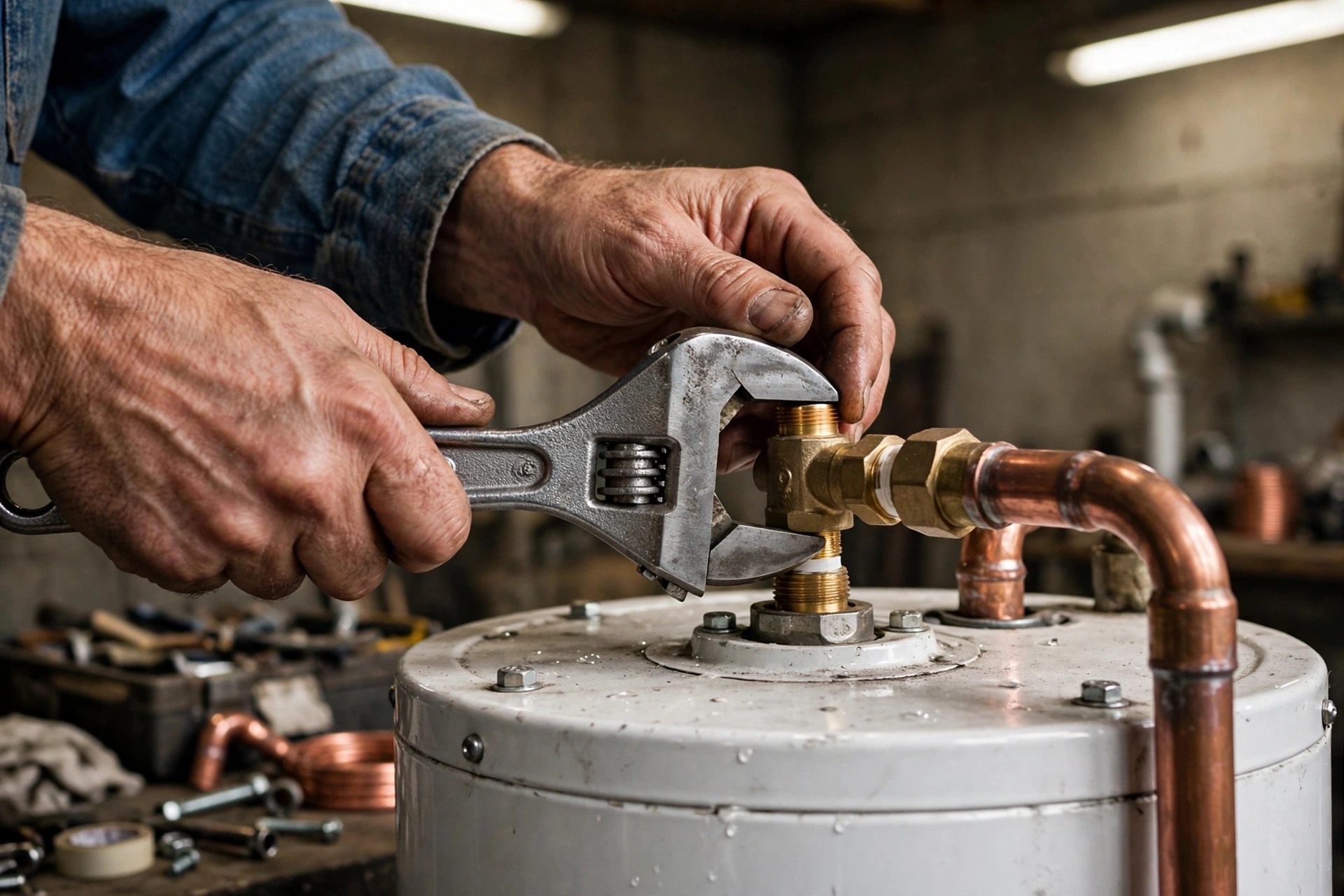
Your water heater is a sealed pressure vessel, and pressure is the silent force behind a surprising number of leaks. When pressure runs too high, the first casualty is usually the T&P relief valve — it starts dripping or discharging to protect the tank. Ignore that warning, and the tank itself becomes the pressure relief. Here is what causes high pressure, how the expansion tank fits in, and what to do about it.

What "too high" actually means
Most homes are designed around water pressure in the 40 to 80 PSI range. Within that band, fixtures work properly and water heaters live normal lives. Sustained pressure above that range — or sharp spikes during heating cycles — stresses every component: supply lines, fixture seals, appliance hoses, and the water heater tank itself. You cannot feel PSI at the tap, which is why high pressure goes unnoticed until something starts dripping.
Cause #1: thermal expansion in a closed system
Water expands when heated — about 2 to 4 percent in volume from cold to hot. In an older "open" plumbing system, that extra volume simply pushed back out into the municipal main. But most modern homes have a check valve, pressure-reducing valve, or backflow preventer that creates a closed system: water can enter, but it cannot push back out. With nowhere to go, the expanded water spikes the system pressure every time the heater runs a full cycle. This is the single most common cause of pressure-related T&P valve dripping we see in Apache Junction homes.
Other causes of high pressure
- Failing pressure-reducing valve (PRV). Many homes have a PRV where the main enters the house. When it wears out, street pressure — often much higher than household plumbing wants — flows straight through.
- High municipal supply pressure. Some neighborhoods simply receive high pressure from the water provider. If your neighbors' T&P valves drip too, suspect the supply.
- Waterlogged expansion tank. An expansion tank with a failed bladder fills with water and stops absorbing expansion — functionally the same as having no tank at all.
- Faulty gauge readings. Before chasing a problem, verify with a known-good gauge. A ten-dollar gauge on an outdoor spigot, left overnight, tells the real story.
Warning signs of excess pressure
The T&P valve dripping or discharging is the headline symptom — it is doing its job, relieving pressure the system cannot handle. Supporting clues include banging or hammering pipes when the heater cycles, toilets that run briefly on their own (the fill valve relieving pressure), dripping faucets that stop after pressure bleeds off, and premature failure of washing machine hoses or fixture cartridges. Any combination of these deserves a pressure check.
The expansion tank's role
An expansion tank is a small tank mounted near the water heater containing a rubber bladder with pressurized air on one side. When heated water expands, it compresses the air cushion instead of spiking system pressure. It is the standard, code-required solution for thermal expansion in closed systems — not an accessory. But it only works if its air charge matches your household pressure and its bladder is intact. A failed expansion tank is invisible from the outside, which is why pressure problems often trace back to a tank nobody has checked in years.
What to do about high pressure
Start by measuring: attach a pressure gauge with a "lazy hand" (peak-hold needle) to a hose bib and leave it for 24 hours, including through a full water-heating cycle. If readings climb well above the normal range during heating, you have a thermal expansion problem — check the expansion tank's air charge and bladder, or add a tank if none exists. If pressure is high around the clock, the PRV or municipal supply is the suspect. Either way, do not just cap or plug a dripping T&P valve — it is the last line of defense between excess pressure and a ruptured tank. If you are seeing these symptoms in Apache Junction, call (833) 713-2101 and we will diagnose the pressure side properly.
Related Questions
Is a dripping T&P valve always a pressure problem?
Not always — the valve itself can wear out and weep at normal pressure. But in a closed plumbing system, thermal expansion is the most common cause, so pressure should be checked before simply replacing the valve.
Can high water pressure damage my water heater?
Yes. Chronic overpressure stresses the tank seams, accelerates T&P valve wear, and shortens the life of every seal and connection in the system — including the heater's.
Do I need an expansion tank if my pressure seems fine?
If your system is closed (check valve or PRV present), thermal expansion is happening whether you notice it or not. Many local codes require the tank; even where not strictly required, it is cheap protection.