Drain Valve Replacement in Apache Junction, AZ
The drain valve is the small spigot at the base of your tank water heater, and in Apache Junction it takes a beating from calcium-heavy water.
- 24/7 Emergency Service
- East Valley Coverage
- Upfront Guidance
In Short
The drain valve is the small spigot at the base of your tank water heater, and in Apache Junction it takes a beating from calcium-heavy water. When it clogs, cracks, or starts dripping, flushing and draining become impossible.
Why Drain Valves Fail in Apache Junction
Drain valves fail for reasons that are almost entirely local. Most factory valves are plastic, and years of 120-degree-plus garage heat make the plastic brittle — we see cracked valve bodies every summer. Hard water does the rest: calcium and sediment settle at the tank bottom right where the valve sits, and the mineral crust either jams the valve shut or scores the seat so it weeps after every flush. A valve that has never been opened in a decade often will not open at all; forcing it snaps the stem. Cross-threading from a past DIY flush, overtightened hose caps, and monsoon-season humidity corroding the hose threads round out the failure list. The symptom homeowners notice first is usually a slow drip from the spout after a flush, or a valve handle that spins without opening. Either way, a failed drain valve is not cosmetic — it removes your ability to service the tank and to drain it quickly in an emergency.
The Replacement Process, Step by Step
We treat this as a small surgical procedure on a pressurized vessel. First, power or gas is shut off and the cold-water inlet closed, then we verify the tank has cooled enough to work safely — draining a full-hot tank risks scalding and thermal shock to the glass lining. A hose goes on the old valve and we drain the tank fully, watching what comes out: clear water means light sediment, while gritty, milky, or chunky discharge tells us the tank needs aggressive flushing. The old valve unscrews with a wrench; if it is plastic and seized, we take care not to crack the tank's threaded port, which would turn a valve job into a tank replacement. The new brass valve gets thread sealant and is torqued to spec. Before refilling, we flush the open port with a short blast of water to push loose sediment out through the larger opening. Then the tank refills completely, air is purged at the hot taps, and power or pilot is restored.
Brass vs. Plastic: Choosing the Right Valve
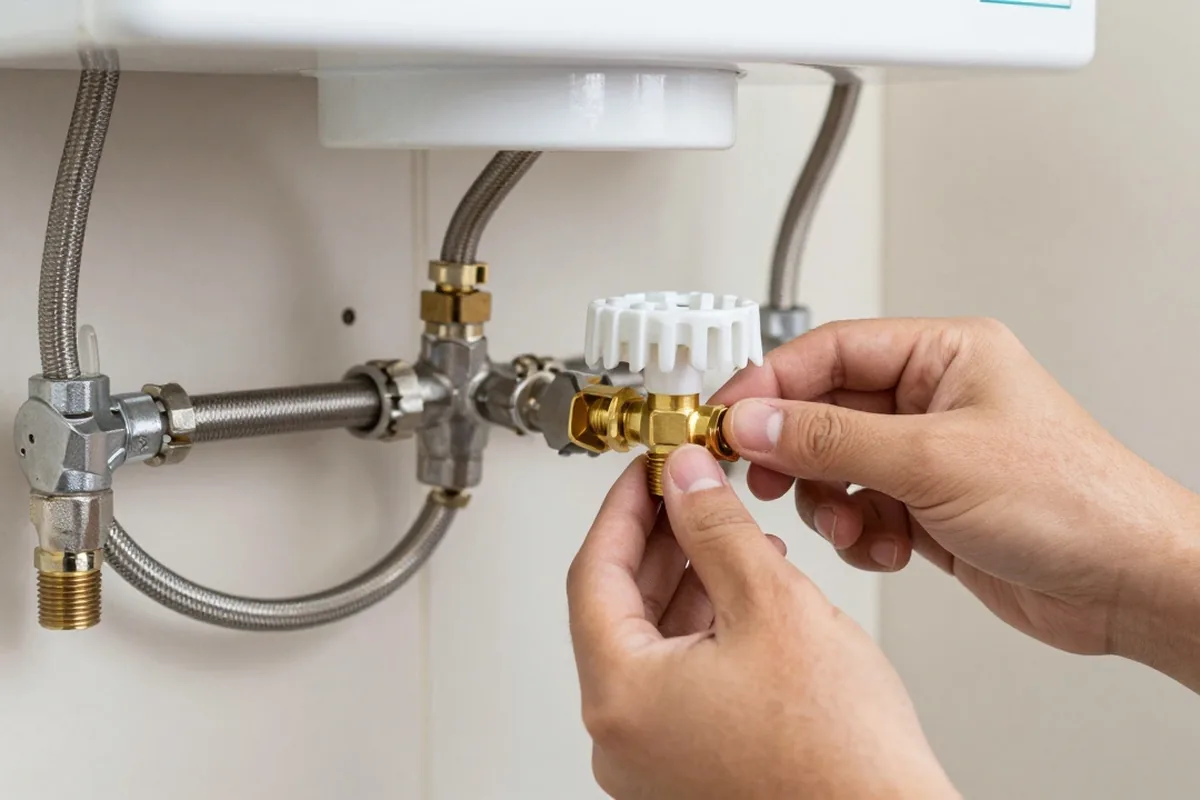
The valve we install matters as much as the labor. Factory plastic gate valves are the root of most problems: narrow passages that clog, stems that snap, bodies that crack in garage heat. We replace them with full-port brass ball valves as standard. Brass handles the heat, the quarter-turn ball mechanism does not rely on a fragile stem, and the full-port bore flows several times more water — which transforms flushing from a trickle into a real cleanout. A quality brass valve also accepts a standard garden hose without the cross-threading drama of worn plastic threads, and it survives being opened and closed annually for the life of the tank. The cost difference over plastic is modest; the reliability difference is enormous. For tanks in tight closets we use a compact-pattern brass valve so the hose connection stays accessible. This is one of those upgrades where the better part is simply the correct part.
Sediment Flushing: The Companion Service
Replacing the valve without addressing the sediment that killed it is half a job, so we pair the two. Apache Junction water leaves calcium carbonate scale the way a kettle does, except the 'kettle' holds 40 or 50 gallons and the scale bakes onto the tank bottom year after year. That layer insulates the burner or lower element from the water, forcing longer, hotter firing cycles — you pay for it in gas or electric bills, and the tank pays for it in thermal stress. During the valve replacement, with the tank empty and a full-port valve going in, we flush aggressively: short, high-volume pulses that stir the sediment bed and carry it out. We keep flushing until the discharge runs clear. Homeowners are often startled by how much comes out of a five-year-old tank that has never been serviced. After the cleanout, the heater recovers faster and runs quieter — rumbling or popping during heating is sediment boiling, and it usually disappears.
Safety: Hot Water, Pressure, and Energy
A drain valve job involves hot water under pressure, 240 volts or live gas, and a heavy tank that must not be energized while empty — so the safety sequence is fixed. We confirm the breaker is off and locked, or the gas control is off, before a drop is drained; firing a burner or element against an empty tank destroys it in minutes. Drained water is hot enough to cause second-degree burns, so discharge goes to a floor drain, exterior grade, or a safe container — never across a walkway or onto landscaping you care about. We wear eye protection when breaking loose a seized valve, because pressurized sediment can spray when the seal gives. After refilling, we open hot taps throughout the house to purge air before restoring energy; trapped air causes water hammer and sputtering that alarms homeowners. Finally, we relight pilots following the manufacturer's sequence and check for gas odor with a detector, not just by nose.
Local Factors: Heat, Hard Water, and Placement
Everything about this service is shaped by the local environment. Garage installations — the norm in Apache Junction — bake plastic valves until they are fragile; we plan for seized, cracked originals on any heater over seven years old. The mineral content here means sediment accumulates roughly twice as fast as national averages, so the flush we pair with the valve swap is not optional, it is the point. Monsoon humidity accelerates corrosion on the valve's hose threads and the tank's steel jacket near the base, so we inspect the surrounding metal for rust-through while the area is exposed. Attic installations in newer builds add a wrinkle: draining must be controlled so a hose failure does not flood ceilings below, and we route discharge with that risk in mind. Hard water also means we check the anode rod while we are there — a depleted rod and a dead valve on the same tank usually travel together.
Frequently Asked Questions
How long does a drain valve replacement take?
It depends on the valve and the sediment load. A simple swap on a tank that drains cleanly is a short visit. If years of calcium have cemented sediment into a solid layer — common in Apache Junction — breaking it up and flushing it out takes longer, and we would rather do it thoroughly than leave a half-cleared tank behind. When you call, tell us the heater's age and whether the valve has ever been opened; that lets us give a realistic time window.
Should I flush my water heater every year?
Yes, and you should. An annual flush is the single best maintenance for a tank heater in hard-water country. The caution: if the heater is over eight years old and has never been flushed, the first flush can dislodge scale that was effectively plugging small weaknesses, occasionally revealing a seep. That is not the flush causing damage — it is the flush revealing damage that was already there. We inspect before flushing older tanks and will warn you if we see risk signs.
My drain valve drips after I flushed the tank. What now?
A slow drip from the valve after a flush is usually debris caught in the valve seat. Try opening the valve fully for a few seconds to blast the seat clean, then close it firmly. If it still weeps, the seat is scored or the plastic body is heat-warped, and the valve needs replacing — which is exactly the service on this page. Do not leave a dripping valve; mineral buildup will eventually cement it open or closed.
Can any tank accept a full-port brass valve upgrade?
On most tanks, yes. The valve threads into a standard 3/4-inch port, and a full-port brass ball valve fits the same opening while flowing dramatically better. The exceptions are a few compact or specialty models with non-standard ports, which we verify before quoting. The upgrade is one of the highest value-per-dollar improvements you can make to an older tank.
Is it worth replacing the valve on an old heater?
If the tank is under six years old and otherwise healthy — good anode, no rust in the water, solid burner or elements — replacing the valve and committing to annual flushes is absolutely worthwhile. If the tank is past ten, the water runs rusty, or the base shows corrosion, put the money toward the replacement fund instead. We will give you a straight assessment during the visit rather than sell you a valve a dying tank does not deserve.
Can I just cap a leaking drain valve?
Only as an emergency stopgap. A cap will stop the drip, but it also removes your only way to drain the tank for future maintenance or in an emergency. Worse, a capped plastic valve under pressure can split at the body. Get the valve replaced properly — it is a short, inexpensive job and it restores a critical safety and maintenance function.
Water Heater Leaking? Call Right Now
One call connects you with an independent local pro ready to help — day or night.
(833) 713-2101