Tankless Water Heater Leak Repair in Apache Junction, AZ
Tankless water heaters leak in different places than tank units — heat exchangers, condensate lines, and precision fittings rather than rusted shells.
- 24/7 Emergency Service
- East Valley Coverage
- Upfront Guidance
In Short
Tankless water heaters leak in different places than tank units — heat exchangers, condensate lines, and precision fittings rather than rusted shells. In Apache Junction, hard water scale is the prime suspect behind most tankless failures.
Where Tankless Units Leak — and What Each Spot Means
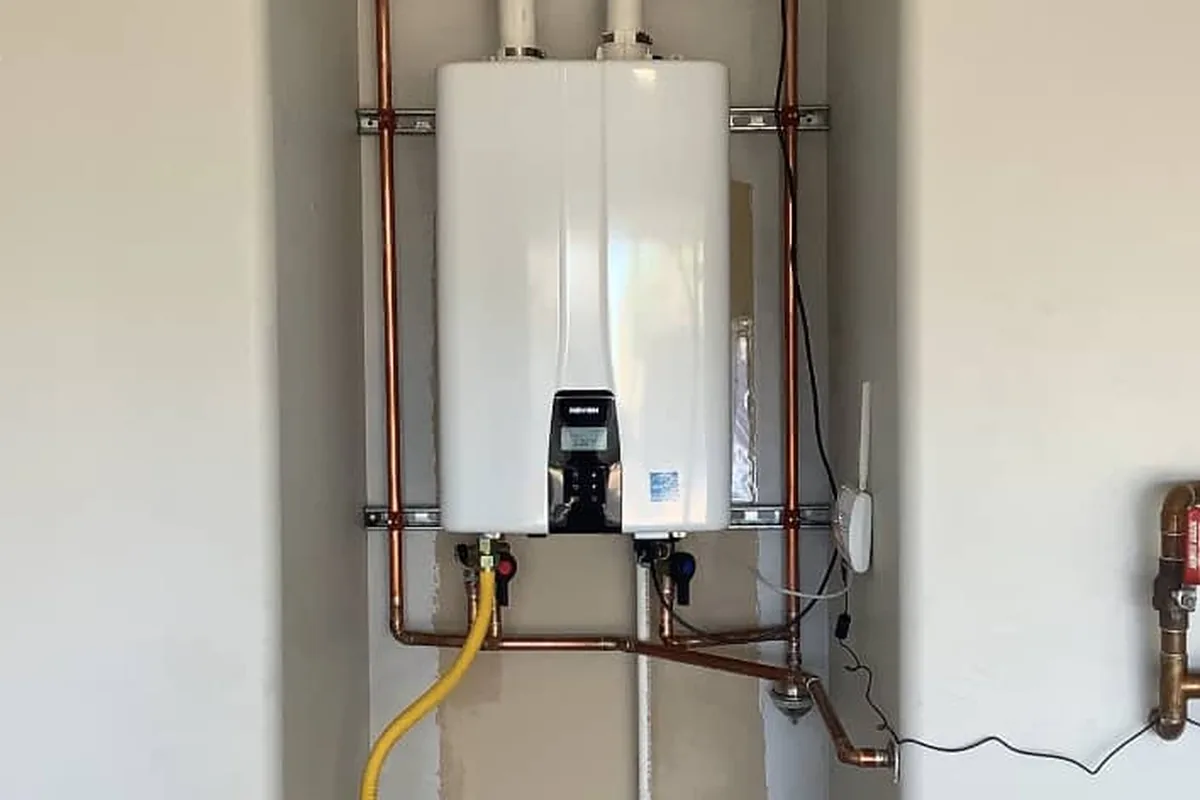
Tankless leaks cluster in a handful of locations, and each tells a different story. The heat exchanger — the copper or stainless core where water flashes to temperature — can develop pinholes or joint leaks after years of thermal stress, especially when scale has been insulating it and creating hot spots. Water connections at the isolation valves and inlet/outlet fittings weep when seals age or when hard-water mineral buildup prevents full seating. Condensing units produce acidic condensate, and a cracked condensate trap or clogged neutralizer backs water up until it finds an exit — often misdiagnosed as a 'mystery leak' at the unit's base. Pressure relief valves on tankless units discharge for the same overpressure reasons as tank units. And internal o-rings and gaskets, baked by years of on-demand firing cycles, eventually harden and seep. The diagnostic art is distinguishing these: condensate is slightly acidic and appears during/after firing, fitting seeps are constant, and exchanger leaks often show as intermittent drips that worsen with demand.
Diagnosis: Reading Codes, Pressure, and Mineral Trails
Tankless diagnosis is more instrumented than tank work because the units are computerized. We start with the error code history — modern units log faults, and codes for overheating, ignition failure, or flow problems narrow the field immediately. Then a visual inspection with the cabinet open (power and gas secured): white or green mineral crust at joints marks slow seeps, while clean water at the base points to condensate. We check the isolation valves and service ports, because many 'unit leaks' are actually valve packing or loose service caps. Inlet water pressure and the pressure relief valve get tested — tankless units are sensitive to pressure spikes. For suspected exchanger leaks, we isolate sections and pressure-test: a exchanger that will not hold pressure has a breach, full stop. Throughout, we photograph findings, because warranty claims on heat exchangers require documentation. The goal is a definitive answer — exchanger, fitting, or condensate — before any part is ordered.
Descaling: The Maintenance That Prevents Most Leaks
Descaling is to tankless units what oil changes are to cars — non-optional, especially here. The procedure uses the unit's isolation valves and service ports: we connect a pump and circulate food-grade descaling solution through the heat exchanger for 45 to 90 minutes, dissolving the calcium carbonate that narrows the waterways. In Apache Junction, a unit descaled annually still yields a surprising amount of dissolved mineral; one neglected for three years can produce a bucket of it. Scale matters because it insulates the exchanger walls — the burner fires harder to push heat through, metal temperatures spike, and thermal stress cracks joints that would otherwise last decades. Most manufacturers require documented descaling to honor heat-exchanger warranties, and in this water they mean it. We pair every leak repair with a descale when the unit is overdue, because fixing the leak without removing the scale that caused it guarantees a return visit.
Heat Exchanger Repair vs. Replacement
When the heat exchanger itself is the leak source, the decision is repair versus replace at the component level. Some exchangers can be repaired — a leaking joint re-brazed, a failed gasket replaced — and on premium units the exchanger may be available as a separate part. We evaluate honestly: a repairable exchanger on a unit with years of life left gets repaired; a cracked exchanger on a twelve-year-old unit with obsolete parts gets a replacement recommendation. Replacement exchangers must match the model exactly — BTU rating, gas type, and venting configuration are all specific. After any exchanger work, we recommission fully: descale, verify gas pressure under full fire, check combustion with an analyzer where applicable, and confirm condensate drainage. A heat exchanger repair without recommissioning is incomplete, because the scale and pressure conditions that stressed the old one are still there waiting for the new one.
Venting and Combustion Safety
Tankless units burn gas on demand, so combustion safety is woven through every repair. We verify venting integrity on every visit: separated vent joints, bird or insect intrusion (common after monsoon season), and proper slope on condensing-unit vents that must drain condensate back correctly. Gas pressure is checked at full fire, not at idle — an undersized or restricted gas line shows up only when the unit demands maximum BTUs, and low pressure causes the delayed ignition and flame rollout that damage exchangers. Carbon monoxide detectors in the home get a mention at every gas-unit visit; we test the area with our own detector during the repair. Electrical grounding matters too — tankless controls are sensitive electronics, and poor grounding causes the phantom error codes that send owners in circles. These checks add minutes and prevent the kind of failures that make the evening news.
Arizona Hard Water and Tankless Longevity
Apache Junction water is the defining fact of tankless ownership here. Hardness among the nation's highest means scale accumulates in months, not years — the annual descale interval that is 'recommended' elsewhere is mandatory here. Many local installations are in garages where summer air tops 120 degrees; that ambient heat does not harm the unit directly, but it accelerates the aging of external seals and the condensate neutralizer media. Dust from monsoon storms infiltrates air intakes and coats flame sensors, causing the ignition faults owners mistake for leaks when the unit locks out and condensate sits. Water pressure in some neighborhoods runs high, which stresses relief valves and fittings — we check pressure at every visit and recommend regulation when it exceeds 80 PSI. The honest summary: a tankless unit here needs more maintenance than the brochure implies, but with annual descaling it delivers its full 15-to-20-year lifespan even in this water.
Frequently Asked Questions
How does hard water cause tankless leaks?
Scale, and it is a bigger deal for tankless than tank units. A tank heater tolerates scale as lost efficiency; a tankless heat exchanger with narrowed passages overheats, throws error codes, and eventually leaks at stressed joints. Annual descaling is the maintenance that prevents most tankless leaks here. If your unit has never been descaled and is over three years old, schedule it before a leak forces the issue.
Will descaling fix my leaking tankless unit?
Descaling is preventive maintenance, not leak repair. If the exchanger is already leaking at a joint or cracked from thermal stress, no amount of flushing seals it. What descaling does is remove the scale that causes the overheating and pressure stress behind many leaks — so it prevents the next failure and is always part of the repair visit, but it is not itself the fix for an active leak.
Can a tankless water heater leak be repaired, or must it be replaced?
Most tankless leaks are repairable: fittings, seals, condensate components, and sensors are all serviceable, and many heat exchangers can be repaired or replaced individually. The economic question is age and parts availability. On a unit under ten years old with a sound exchanger, repair almost always wins. Past twelve to fifteen years, compare the repair against a new unit with a fresh warranty.
What should I do if my tankless unit starts leaking?
Check the obvious first: the condensate drain for clogs, the isolation valves for tightness, and whether the unit shows an error code — photograph the code before resetting. Shut the water isolation valves if the leak is active and contained. Do not open the cabinet or touch gas components. Then call (833) 713-2101 with the brand, model, and error code if any.
Is the annual flush really necessary?
Yes, and it is the highest-value maintenance a tankless owner here can do. The flush valves make it a clean procedure with no mess. Skipping it in Apache Junction water voids most manufacturer warranties in practice — they require proof of maintenance for scale-related claims, and scale is the default assumption here. Annual is the interval; every two years is gambling.
Are tankless repairs expensive?
Heat exchanger work runs higher than tank-heater repairs because the parts are precision components and the labor involves combustion systems. That said, a fitting or condensate repair is comparable to any plumbing fix. We quote before work begins, and we will tell you plainly when a repair approaches the cost of replacement — no one should pay 60 percent of a new unit to extend an old one by two years.
Water Heater Leaking? Call Right Now
One call connects you with an independent local pro ready to help — day or night.
(833) 713-2101