Water Heater Leak Detection in Apache Junction, AZ
Finding where a water heater leak actually starts is harder than it looks — water runs downhill and pools far from its source. Accurate detection prevents paying for the wrong repair.
- 24/7 Emergency Service
- East Valley Coverage
- Upfront Guidance
In Short
Finding where a water heater leak actually starts is harder than it looks — water runs downhill and pools far from its source. Accurate detection prevents paying for the wrong repair.
Why Leak Sources Are Hard to Find
Water heater leaks are deceptive by physics. Water obeys gravity, not convenience: a seep from a top fitting runs down the jacket and pools at the base, looking exactly like a tank-bottom failure. A sweating cold-water pipe three feet away drips onto the floor and migrates under the heater. Condensation during monsoon season forms on the tank jacket itself and drips from the bottom edge — indistinguishable from a shell leak to the naked eye. In attic installations, water travels along joists and drywall, staining ceilings far from the unit. Slow seeps evaporate in 115-degree garage heat between observations, so the puddle appears and vanishes. And multiple small issues often coexist — a weeping union plus condensation — creating a composite symptom no single glance explains. This is why 'there is water under the heater' is a starting observation, not a diagnosis, and why replacing parts on a hunch wastes money. Detection is a discipline: dry everything, watch systematically, and let the water reveal its path.
Our Detection Process, Step by Step
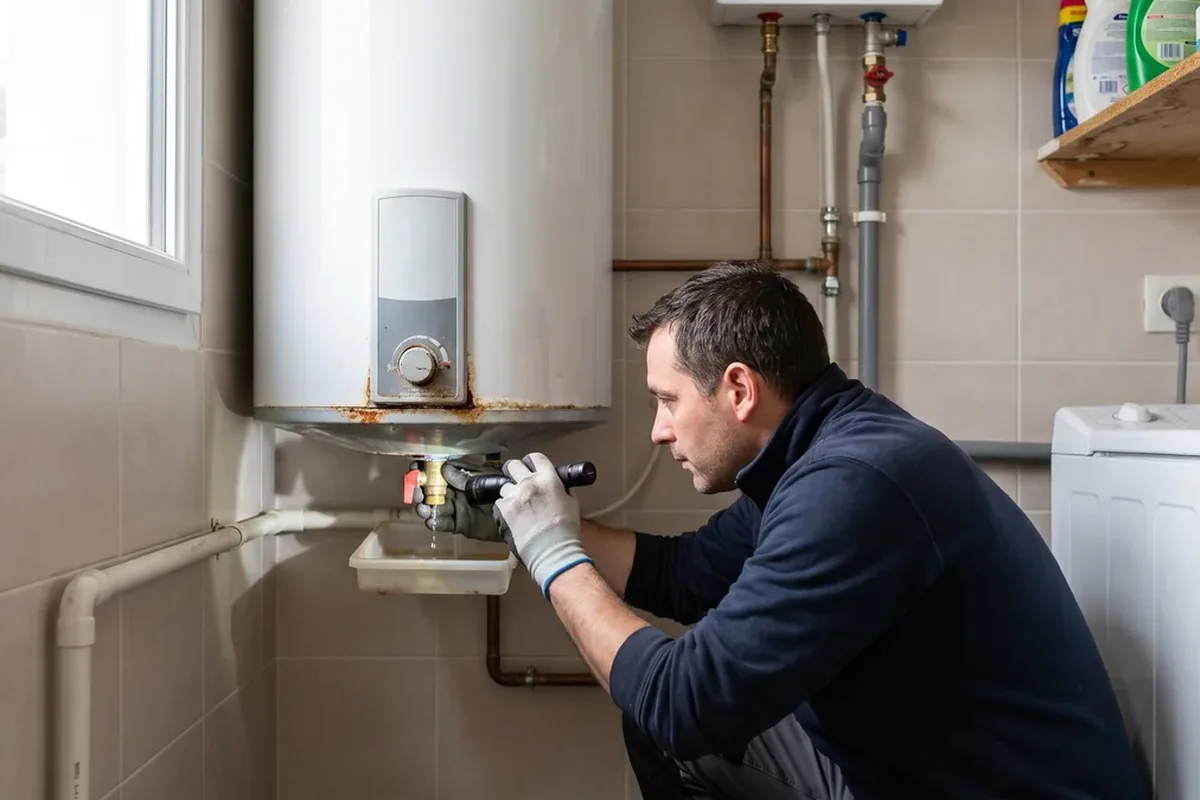
Our detection visit follows an elimination sequence refined over hundreds of local calls. First we dry the entire area — tank base, fittings, floor, nearby pipes — so every new wetness is fresh evidence. Then we inspect from the top down: inlet and outlet connections, dielectric unions, and flex connectors get checked for green copper corrosion or rust staining, the mineral fingerprints of slow seeps. The T&P discharge pipe is felt for warmth and moisture. Drain valve, element gaskets, and gas control threads follow. If the source is still unclear, we bring instruments: a pinless moisture meter maps dampness in drywall and flooring around the unit, and a thermal camera highlights evaporative cooling patterns that suggest hidden moisture paths. For intermittent leaks, we run the heater through a full heating cycle and watch — expansion and pressure change with temperature, and some seeps only appear at full heat. The visit ends with a written finding: the source, the evidence, and the recommended fix.
The Tools: Meters, Cameras, and Dye
Different leaks require different instruments, and we carry the full kit. Pinless moisture meters read dampness through drywall, tile, and concrete without damage — essential for mapping how far water has spread from an attic or garage unit into adjacent rooms. Pin-type meters confirm readings in wood framing and baseboards. Thermal imaging cameras visualize temperature differences: wet areas cool by evaporation and show clearly, letting us trace a leak's path across a ceiling or slab without opening anything. For dye testing, we add fluorescent tracer to the tank water — if the suspect puddle fluoresces under UV light, it came from the tank; if not, the source is elsewhere, such as a nearby supply line or condensation. Inspection cameras snake into wall cavities and under platforms to view hidden fittings. And a simple manometer pressure test can reveal whether system overpressure is driving T&P discharge that mimics a leak. No single tool proves everything; the combination is what makes the diagnosis reliable.
The Usual Suspects: Hidden Leak Spots We Check First
Experience has taught us where to look first, and the list is specific. Dielectric unions — where copper house piping meets steel tank nipples — are the number-one slow-seep point; the dissimilar-metal junction corrodes predictably. Flex connectors develop pinholes at their corrugation valleys, often spraying a fine mist that looks like general dampness. The T&P discharge pipe termination is a frequent 'mystery puddle' source when the valve weeps intermittently. Drain valves with scored seats weep only after heating cycles, when expansion raises pressure slightly. On electric units, element gaskets harden and seep down the tank side. Condensate-like dripping on gas units in summer is often just humid air on the cold inlet pipe — not a leak at all. And in attic installations, the pan drain line itself clogs with dust and overflows, mimicking a tank leak while the tank is perfectly sound. Each of these has a distinct signature, and recognizing them is what turns an hour of detection into a precise repair quote.
After Detection: From Finding to Fix
Detection is only valuable if it leads to the right action, so every visit ends with a clear report and options. If the source is a fitting, valve, or component, we quote the repair on the spot — most are same-day fixes from truck stock, and the diagnostic fee applies toward the work. If the source is the tank shell, we explain why repair is not an option and quote replacement, including same-day installation availability for standard sizes. If the source is condensation or an external pipe, we say so plainly and charge only the diagnostic — there is no repair to sell, and inventing one would be dishonest. When water has spread into drywall, flooring, or insulation, we document the extent with meter readings and photos for your insurance claim, and we advise on dry-out before repairs are closed up. You leave knowing exactly what is wrong, what it costs to fix, and what happens if you wait — which is the entire point of professional detection.
Local Factors: Monsoon, Heat, and Hard-Water Fingerprints
Apache Junction conditions create leak-detection puzzles found nowhere else. Monsoon humidity from July through September generates condensation that perfectly mimics leaks — cold inlet pipes sweat, tank jackets drip, and pan drains show water with no failed component. Our August detection visits start with a condensation assessment before any wrench turns. Garage heat over 120 degrees evaporates small seeps between observations, so intermittent leaks need watched heating cycles rather than spot checks. Hard water leaves mineral fingerprints — white crust at a joint is a historical record of seepage even when the joint is currently dry, and we read those trails like a map. Attic installations in newer builds are the highest-stakes detection calls: water travels along truss chords and stains ceilings rooms away, and thermal imaging earns its keep tracing the path back. Dust is the final local quirk — it clogs pan drains and coats flame sensors, creating secondary symptoms that muddy the primary diagnosis. Local experience is not a slogan here; it is the difference between finding the leak and finding a leak.
Frequently Asked Questions
How long does leak detection take?
A diagnostic visit typically runs 30 to 60 minutes depending on how hidden the source is. Obvious fitting leaks are identified in minutes; intermittent seeps that only appear at full temperature may need the heater run through a heating cycle while we watch. We quote the diagnostic before starting, and if you proceed with the repair, the diagnostic fee is applied to the work.
Can condensation really look like a leak?
It can, and August is our peak month for it. Humid monsoon air condenses on cold inlet pipes, the tank jacket, and nearby cold-water lines, dripping convincingly onto the floor. The telltales: it appears on humid days, the water is clean and room-temperature, and the highest wet point is a cold pipe, not the tank. Part of our detection visit is ruling condensation in or out before any repair is quoted.
Do you detect leaks from attic water heaters?
Yes — attics are where hidden leaks do the most damage, dripping through drywall and insulation long before anyone looks up. We bring moisture meters and thermal imaging to map the spread without tearing open ceilings unnecessarily. If you see a ceiling stain below an attic heater, call promptly: every day of delay spreads the damage and the repair bill.
Can a sewer camera help find a water heater leak?
Often, yes. The camera shows the inside of drain lines and wall cavities without demolition, confirming whether water traveled from the heater area or originated elsewhere. For slab-adjacent garage installations, it can rule out a slab leak masquerading as a heater leak — an important distinction, because the repairs are completely different.
Is a small leak an emergency?
Only in the sense that a small seep can become a burst with little warning, especially on tanks past ten years. A weep from a fitting is stable and repairable on a normal schedule; a weep from the tank shell is a countdown. Our detection report tells you which one you have and how urgent it is, so you are deciding from facts, not fear.
How accurate is thermal imaging for leaks?
Thermal cameras detect surface temperature differences, not water itself — they show the cooling pattern of evaporation, which strongly suggests moisture but is not proof. That is why we always confirm with a pin or pinless moisture meter before declaring a source. Anyone who diagnoses from a thermal image alone is guessing; we use it as a pointer, then verify.
Water Heater Leaking? Call Right Now
One call connects you with an independent local pro ready to help — day or night.
(833) 713-2101